
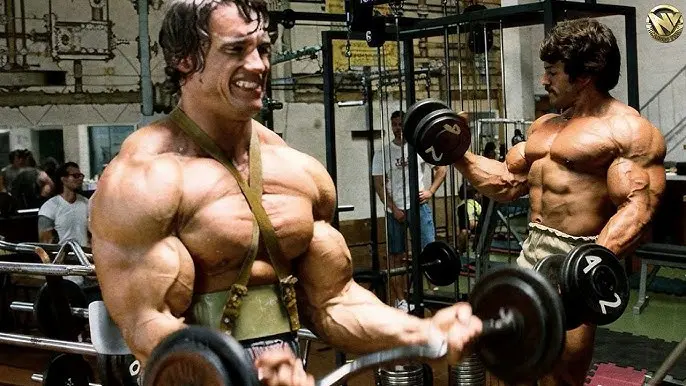

The Golden Era of bodybuilding, spanning roughly the 1960s through the early 1980s, was defined by an obsession with aesthetic proportions, wide shoulders, narrow waists, and flowing lines, rather than sheer mass. Athletes trained with high volume and intense focus on the mind-muscle connection, ate simple high-protein diets, and used relatively modest doses of classic anabolic steroids like Dianabol and Primobolan. The result was physiques that looked like classical sculpture, built in small community gyms without social media or macro-tracking apps.
Key Takeaways
The Golden Era ran from the 1960s into the early 1980s, with roots stretching back to the 1950s.
Icons like Arnold Schwarzenegger, Frank Zane, Franco Columbu, and Serge Nubret set the aesthetic standard.
Training emphasized high volume, compound lifts, and six-day split routines with strong mind-muscle connection.
Diets were simple: high protein and moderate-to-high healthy fats from whole eggs, steak, and dairy, paired with moderate-to-low carbohydrates.
Steroid use centered on Dianabol, Deca Durabolin, and Primobolan at lower doses than modern protocols.
Body fat typically sat around 6-10%, creating a lean, athletic look rather than extreme shredding.
The V-taper and X-frame were the central design goals, broad shoulders, tight waist, balanced proportions.
Classic Physique divisions today exist largely as a reaction against modern mass-monster bodybuilding.
What Years Were Considered the Golden Era of Bodybuilding?
The Golden Era of bodybuilding is generally defined as running from the 1960s into the early 1980s, though some historians trace its roots back to the 1950s. This period produced the sport's most iconic figures and established aesthetic standards that still influence bodybuilding today.
Key figures who defined the era include:
Arnold Schwarzenegger, seven-time Mr. Olympia and the era's most famous ambassador
Franco Columbu, compact, powerful, and a two-time Mr. Olympia
Frank Zane, three-time Mr. Olympia known for proportion and symmetry
Serge Nubret, French star famous for his flowing, artistic physique
Larry Scott, the first-ever Mr. Olympia winner
Sergio Oliva, "The Myth," known for unmatched mass and shape
Dave Draper, the Blond Bomber, a fan favorite
Rachel McLish and Lisa Lyons, pioneers of women's bodybuilding aesthetics
These athletes built their physiques in an era before the internet, before supplement companies dominated the industry, and before bodybuilding shifted toward maximizing size at any cost.
Golden Era Bodybuilding Physique vs Modern Bodybuilding
Golden Era physiques prioritized the V-taper and X-frame: broad shoulders and lats, a tight waist, and balanced upper-to-lower body proportions. Modern bodybuilding, by contrast, shifted toward maximizing size and conditioning, producing "mass monsters" that often sacrifice the classic lines of the Golden Era.
The Golden Era athlete saw his body as a work of art to be refined over years, not a machine to be overloaded with mass.
Body fat levels in the Golden Era typically sat around 6-10%, creating a lean, athletic look. Today's pros often push to more extreme shredding and dehydration, which can come with visible health costs. The smaller waists and less exaggerated muscularity of Golden Era champions came from a combination of different pharmacology, lower dosages, and a stronger aesthetic focus.
Judging criteria also differed. Golden Era competitions rewarded symmetry, proportion, and artistic posing routines. Modern judging in the open class tends to reward sheer mass and conditioning, which is why Classic Physique divisions were created as a reaction against this trend.
A common misconception is that 1970s bodybuilders were bigger than today's athletes. In reality, modern pros carry significantly more mass. The Golden Era look appears more impressive to many fans because the proportions create an illusion of size and power without the blocky thickness or abdominal distension seen in current open-class competitors.
Golden Era Bodybuilding Training Methods vs Modern
Golden Era training relied on high volume, consistent frequency, and a strong mind-muscle connection. Many athletes trained six days per week using split routines that intensely targeted specific muscle groups, often with morning and evening sessions.
The backbone of their routines was compound lifts:
Squats
Deadlifts
Bench presses
Barbell rows
Pull-ups
Dumbbell pullovers
Sessions were long and brutal. Modern training tends to favor lower volume, higher intensity techniques, and more data-driven programming. Recent experiments where modern lifters try full Golden Era routines report that they are brutally high-volume but effective at building dense, well-rounded musculature and stronger mind-muscle engagement.
Common mistake when replicating Golden Era training: Jumping into six-day, twice-a-day training without the conditioning to handle it. If you want to try this style, scale up gradually, start with four days and add volume over weeks, not days.
Arnold Schwarzenegger Golden Era Bodybuilding Techniques
Arnold's approach combined high-volume training with a "physique as sculpture" mindset. He chose exercises and angles deliberately to refine specific visual qualities, biceps peak, chest fullness, sweeping lats, even though modern science suggests muscle shape is largely genetic.
Arnold's signature techniques included:
High-volume sets, often 20+ sets per body part
Supersets and drop sets, to push past failure
Mind-muscle connection, focusing intensely on the contraction rather than just moving weight
Twice-daily training, splitting body parts across morning and evening sessions
He trained at Gold's Gym in Venice, California, surrounded by other champions, which created a competitive fire that pushed everyone to train harder.
Golden Era Bodybuilding Diet and Nutrition Secrets
Golden Era nutrition was simple by today's standards. Athletes ate high protein and ample dietary fats from whole foods, keeping carbohydrates moderate to low to stay lean while maintaining energy and hormonal health.
A typical day might include:
Breakfast: Eggs, steak, and whole milk
Lunch: Chicken or beef with vegetables
Dinner: Fish or steak with a salad
Snacks: Cottage cheese, desiccated liver tablets, brewer's yeast
There were no macro-tracking apps, no meal prep services, and no exotic supplement stacks. Old-school supplements were basic: desiccated liver tablets, brewer's yeast, and simple egg protein powders.
Nutritional context: Unlike the ultra-low-fat craze of the 1990s, Golden Era bodybuilders embraced dietary fats from whole milk, egg yolks, and beef, often using early cyclical low-carb or keto-style protocols (popularized by coaches like Vince Gironda).
What Steroids Did Golden Era Bodybuilders Use?
Golden Era bodybuilders relied on classic anabolic steroids, primarily Dianabol, Deca Durabolin, and Primobolan. These compounds produced significant muscle gains without the extreme androgenic side effects associated with some modern compounds.
Key differences from modern drug use:
Lower overall dosages, Golden Era athletes used far less than today's professionals
Fewer compounds, typically one or two at a time rather than complex stacks
No insulin and virtually no HGH; recombinant growth hormone and insulin mega-dosing protocols did not emerge until the late 1980s and 1990s
Aesthetic focus, drugs were chosen to enhance proportion, not raw mass
This pharmacological approach contributed to the smaller waists and less exaggerated muscularity seen in Golden Era champions versus many present-day professionals.
Was Golden Era bodybuilding healthier or more dangerous? In some ways, it was likely less risky, lower doses, fewer compounds, and no extreme dehydration protocols. But the lack of medical oversight, bloodwork monitoring, and post-cycle therapy knowledge made it dangerous in its own right. The era was neither a health paradise nor a free-for-all; it was simply different.
Golden Era Bodybuilding Community and Culture Differences
Golden Era gym culture was built around small, rugged, community-focused gyms. There was no social media, no macro-tracking apps, and no remote coaching. Athletes trained together in person, competing and learning face-to-face.
This environment created:
Competitive fire, training alongside champions pushed everyone harder
Camaraderie, shared suffering built real bonds
Knowledge transfer, tips and techniques passed directly from veteran to novice
No digital comparison, you judged yourself against the guy next to you, not an Instagram filter
Today's environment is more digital, individualized, and data-driven. While that has benefits, better information access, smarter programming, many lifters feel something was lost when the community gym culture faded.
Can You Achieve a Golden Era Physique Today?
Yes, you can build a Golden Era-inspired physique today, but you need to understand what that means. It's not about copying exact steroids cycle or eating nothing but steak and eggs, it's about prioritizing proportion, symmetry, and aesthetic lines over raw mass.
To train like a Golden Era bodybuilder:
Focus on the V-taper, prioritize lats, shoulders, and upper chest
Use compound lifts as your base, squats, deadlifts, rows, presses
Train with volume and frequency, aim for 4-6 days per week
Develop mind-muscle connection, feel every rep, don't just move weight
Keep body fat moderate, 8-12% is plenty for a classic look
Practice posing, treat presentation as part of the craft
Common mistakes people make trying to replicate it:
Copying pro-level volume without the recovery capacity
Ignoring nutrition in favor of "just eating steak and eggs"
Expecting results without the years of consistent effort the era's champions put in
Assuming the look is purely genetic when much of it comes from smart, targeted training
Best Golden Era Bodybuilding Documentaries and Movies
The best way to understand Golden Era bodybuilding culture is to watch the people who lived it. These films and documentaries capture the training, the camaraderie, and the mindset that made the era special.
Pumping Iron (1977), the definitive Golden Era documentary, following Arnold and his rivals leading up to the 1975 Mr. Olympia
Pumping Iron II: The Women (1985), covers the early days of women's bodybuilding
Generation Iron (2013), a modern look at the sport with heavy Golden Era callbacks
Various YouTube retrospectives and training recreations, modern lifters attempting classic routines and comparing results
Recent content from 2025-2026 shows a surge of practical experiments where modern lifters attempt full Golden Era routines. A May 2026 video documents a lifter trying a traditional Golden Era program, while January 2026 content recreates classic back-day sessions using forgotten exercises and old-school techniques.
FAQ
What years were the Golden Era of bodybuilding?
The Golden Era ran from the 1960s into the early 1980s, with some historians tracing roots back to the 1950s.
Who were the top Golden Era bodybuilders?
Arnold Schwarzenegger, Franco Columbu, Frank Zane, Serge Nubret, Larry Scott, Sergio Oliva, and Dave Draper were the era's defining figures.
What made Golden Era physiques different?
They prioritized the V-taper, symmetry, and proportion over raw mass. Body fat sat around 6-10%, and waists stayed tight.
What steroids did Golden Era bodybuilders use?
Primarily Dianabol, Deca Durabolin, and Primobolan, at lower doses than modern protocols and without insulin or HGH.
How did Golden Era bodybuilders train?
High volume, compound lifts, six-day splits, and strong mind-muscle connection, often with twice-daily sessions.
What did Golden Era bodybuilders eat?
High protein and moderate-to-high fat from whole eggs, red meat, and dairy, moderate to low carbs, and simple supplements like liver tablets and brewer's yeast.
Can you build a Golden Era physique naturally?
You can build a proportion-focused, aesthetic physique naturally, though you won't match the exact size of era champions without pharmaceutical assistance.
Was Golden Era bodybuilding healthier than today?
In some ways yes, lower doses and no extreme dehydration, but the lack of medical monitoring made it risky in its own right.
Why do people still admire Golden Era bodybuilding?
The proportions, posing artistry, and community culture represent an aesthetic ideal that many find more appealing than modern mass-focused bodybuilding.
What's the best documentary about Golden Era bodybuilding?
Pumping Iron (1977) is the definitive film, capturing the training, rivalry, and culture of the era.
Conclusion
The Golden Era of bodybuilding was unique because it treated the physique as art, not just a collection of muscles. Athletes trained with purpose, ate simply, and built proportions that still define what most people consider an ideal body today.
If you want to apply Golden Era principles to your own training:
Prioritize proportion over mass, train for the V-taper, not just size
Master the basics, compound lifts, consistent volume, and real food
Develop your mind-muscle connection, every rep should have intent
Embrace community, train with people who push you, even if that means finding a smaller, grittier gym
Be patient, the physiques you admire took years, not weeks
The era's ideals, balanced proportions, moderate body fat, artistic posing, and community-focused training, will keep influencing the sport through Classic Physique and old-school training movements. You don't need to live in 1975 to train like you do.